ENGINEERING GUIDE · BRACKISH WATER RO
What is brackish water RO—and where is it used?
Understand the source, conductivity, treatment steps and verified DESAL-BWRO routes before comparing equipment.
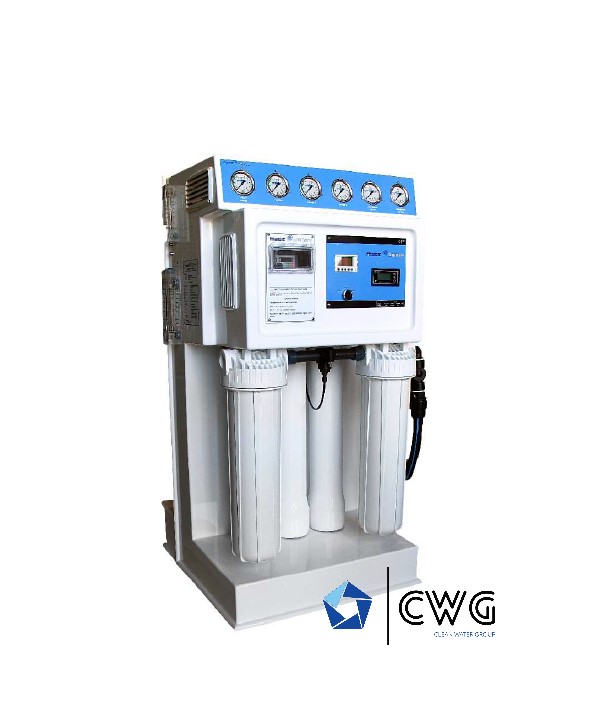
Brackish water RO is pressure-driven membrane separation for a mineralised non-seawater source.
The membrane divides the pressurised feed into treated permeate and a more concentrated reject stream. A complete system also addresses pretreatment, chemistry, product-water conditioning, storage, controls and discharge.
CONDUCTIVITY, TDS & CHEMISTRY
One salinity number is not a treatment design.
Conductivity measures how readily water carries electrical current and is strongly influenced by dissolved ions. TDS reports dissolved-solids concentration. They are related, but their conversion is not universally exact because ionic composition and measurement conditions differ.
Use conductivity to route the initial catalog search. Use the full laboratory analysis to assess scaling, fouling, materials, recovery, pretreatment and the achievable product-water quality.
PUBLIC CONDUCTIVITY ROUTES
Five catalog classes. One measured starting point.
The table is a preliminary route map, not a guarantee. LR remains a permeate-quality configuration and is not inserted as a sixth salinity class.
Open Watermaker Finder≤ 4,400 µS/cm
DESAL-BWRO KPLowest published KP conductivity configuration.
4,401–6,000 µS/cm
DESAL-BWRO Q · XP · KPCompact through commercial catalog routes.
6,001–10,000 µS/cm
DESAL-BWRO Q · XP · KPQ reaches its published conductivity boundary.
10,001–15,500 µS/cm
DESAL-BWRO XP · KPHigher brackish-water catalog duty.
15,501–22,000 µS/cm
DESAL-BWRO KPUpper published DESAL-BWRO conductivity configuration.
WHERE BRACKISH WATER RO IS USED
Applications share the membrane principle—not the same design.
Source chemistry, final-water use, daily duty, storage and operating conditions change the required process.
Villas & homes
Private supply from a verified well or borehole, matched to occupancy, storage and final-water use.
Open applicationHotels & resorts
Hospitality demand where rooms, kitchens, laundry, cleaning and seasonal peaks share one water balance.
Open applicationCamps & temporary sites
Phased water production for changing occupancy, site utilities and deployment conditions.
Open applicationIrrigation
Feed-water treatment assessed together with crop, soil, ions, blending and seasonal irrigation demand.
Open applicationIndustry
Process or utility-water production defined by source variability, required quality and availability.
Open applicationMunicipal supply
Distributed production where storage, potable-water conditioning and operator capability are project inputs.
Open applicationHOW THE COMPLETE PROCESS WORKS
RO is one stage inside the water service.
Every treatment stage is selected from the source and final duty; no universal pretreatment train is assumed.
Characterise the source
Verify analysis, sampling condition, source yield, temperature and seasonal range.
Control suspended matter
Select filtration from turbidity, SDI where available and actual particulate loading.
Manage chemistry
Assess hardness, alkalinity, silica, metals and other scaling or fouling risks.
Apply membrane separation
Pressure drives water through the RO membrane while dissolved constituents are retained.
Manage concentrate
Define reject flow and the approved discharge or further-treatment boundary.
Condition product water
Post-treatment depends on the final drinking, process, irrigation or utility-water requirement.
PRETREATMENT & SCALING CONTROL
Protect the membrane from measured risks.
Do not copy one pretreatment package from another site. Review the source condition together with the intended recovery, membrane limits, operating schedule and cleaning strategy.
Review RO technologyParticles & colloids
Turbidity, suspended solids and SDI where relevant
Fouling and pressure-loss riskScaling chemistry
Hardness, alkalinity, sulphate, silica and operating recovery
Mineral precipitation riskIron & manganese
Dissolved and oxidised forms plus sampling condition
Deposits, oxidation and foulingOrganics & microbiology
Source history, organic indicators and microbiological risk
Biofouling and cleaning dutyOxidants & chemicals
Disinfection plan, residual oxidants and membrane compatibility
Membrane and materials protectionCAPACITY SELECTION
Convert daily demand into realistic operating duty.
Preliminary nominal output equals approved treated-water demand per day divided by realistic RO operating hours, with only a stated and justified reserve. Storage serves short peaks and defined interruptions.
Open Brackish Water RO CalculatorDESAL-BWRO FAMILY POSITIONING
Q, XP and KP cover different catalog duties.
Published values are comparison boundaries. Missing specifications are not inferred from adjacent models.
DESAL-BWRO Q
- OUTPUT
- 50–125 L/h
- CONDUCTIVITY
- Up to 10,000 µS/cm
- PUBLIC CONFIGURATIONS
- HL · L
Compact brackish-water production for homes and small facilities.
View verified catalogDESAL-BWRO XP
- OUTPUT
- 22.5–125 L/h
- CONDUCTIVITY
- Up to 15,500 µS/cm
- PUBLIC CONFIGURATIONS
- HL · L · M · LR
Flexible compact route for residential, hospitality and light-commercial duty.
View verified catalogDESAL-BWRO KP
- OUTPUT
- 164–2,500 L/h
- CONDUCTIVITY
- Up to 22,000 µS/cm
- PUBLIC CONFIGURATIONS
- WHL · HL · L · M · R · LR
Commercial and industrial production for hospitality, irrigation, process and utility applications.
View verified catalogData boundary: final pressure, recovery, pump power, electrical supply, permeate quality, pretreatment, dimensions and performance are published or guaranteed only where the specific approved source confirms them.
DATA FOR ENGINEERING REVIEW
Bring source, demand and site together.
A model match becomes meaningful only when it belongs to one complete operating case.
BRACKISH WATER RO FAQ
Answers before model selection.
01What is brackish water reverse osmosis?
Brackish water RO uses pressure and a semipermeable membrane to separate water from dissolved salts and other retained constituents in a non-seawater source. The complete process can also include source pumping, pretreatment, dosing, post-treatment, storage and controls.
02Is brackish water defined by one exact TDS value?
Terminology varies, so SEAMASTER does not select equipment from one generic TDS definition. The public catalog route uses measured feed-water conductivity, while final design uses the complete source-water analysis and required product quality.
03Can TDS be calculated exactly from conductivity?
No universal exact conversion applies to every water. The relationship depends on ionic composition and measurement conditions. Use laboratory TDS and conductivity values where available and treat field conversions only as preliminary estimates.
04What does LR mean in the DESAL-BWRO catalog?
LR is a permeate-quality configuration, not an additional feed-water conductivity class. It is used only where the published model data and final engineering review support that configuration.
05Does matching conductivity and capacity complete the selection?
No. It creates a catalog-based starting point. Pretreatment, recovery, product-water quality, pressure, power, materials, operating limits and performance are confirmed only from verified project data and the approved technical proposal.
Open the DESAL-BWRO catalog.
Filter Q, XP and KP from measured conductivity and required production, then confirm the project with CWG engineering.