01
Brackish well or borehole
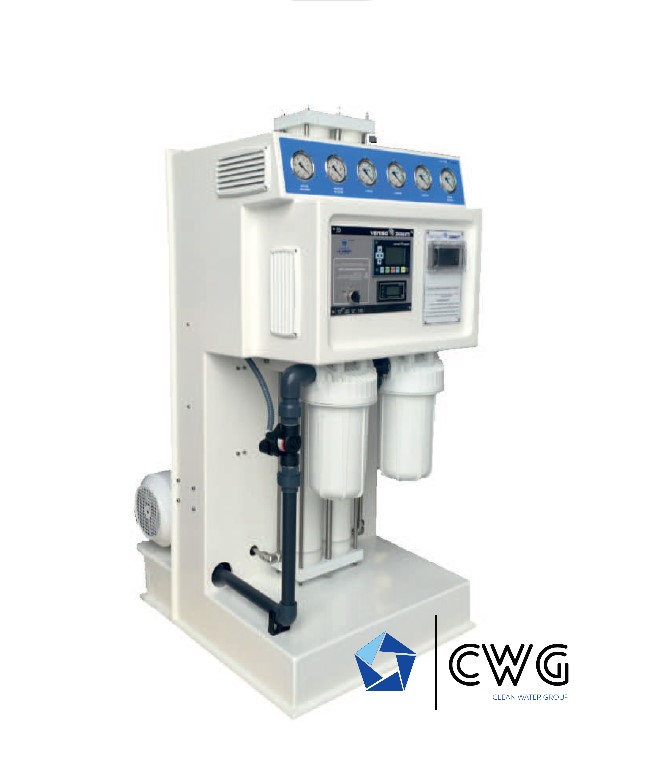
DESAL-BWRO Q / XP- Source boundary
- Measured conductivity required
- Compact output
- 22.5–125 L/h

VILLAS & HOMES · INDEPENDENT WATER SUPPLY
Plan a quiet, automated residential supply around the real source water, occupancy, storage volume and preferred operating schedule.
BRACKISH OR SEAWATER
A brackish borehole leads to DESAL-BWRO. A seawater intake leads to DESAL-SWRO. Within that route, daily volume, operating hours and usable storage define the required production rate.
SOURCE-WATER DECISION
Location does not define the technology. The measured feed water does.
Brackish well or borehole
DESAL-BWRO Q / XPDirect seawater source
DESAL-SWRO PM-CHardness, alkalinity, iron, manganese, silica, turbidity or SDI, organics, temperature and seasonal variation determine pretreatment, recovery and membrane duty.
PRELIMINARY RESIDENTIAL SIZING
Illustrative calculations before design reserve, water analysis and project engineering.
Brackish source; model class follows measured conductivity.
Compact brackish-water route after a complete water analysis.
Technology is selected by the actual brackish or seawater source.
354.17 L/h is the next PM-C catalog output before design reserve.
 STEADY PRODUCTION · STORED RESERVE
THE STORAGE PRINCIPLE
A product-water tank supplies short peak demand while the treatment system produces at a stable rate. This allows a smaller, more controlled plant and an operating schedule selected around noise, power availability and source conditions.
Tank sizing, turnover, materials, venting, level control, post-treatment and disinfection are confirmed for the project.
RESIDENTIAL ENGINEERING CHECK
Capacity is only one part of the installation.
Conductivity alone is not enough. Check hardness, alkalinity, iron, manganese, silica, turbidity or SDI and source variability.
Separate normal occupancy from guest peaks, pool top-up, irrigation and cleaning so the plant is not sized from an unrealistic average.
A correctly sized product-water tank decouples household peak flow from the RO production rate and allows quieter operating windows.
Confirm available electrical supply, protection, drainage, feed pressure and any need for backup operation before fixing the model.
Allow ventilation, dry service space, filter replacement, membrane access and safe chemical handling—not only cabinet dimensions.
Drinking, general household use, irrigation or equipment feed can require different post-treatment, storage and disinfection.
DESIGN FOR REAL OCCUPANCY
A summer villa may combine maximum occupancy, showers, laundry, pool top-up, landscape irrigation and the warmest source-water condition at the same time.
DATA FOR A TECHNICAL REVIEW
Preliminary information is enough to identify the route and missing project inputs.
Send project dataChoose the source-water class and required production. The Finder identifies the smallest qualifying catalog starting point before engineering review.
VILLA & HOME FAQ
Bedrooms provide an occupancy clue but not a complete demand. Use expected people, actual daily consumption, guest peaks, laundry, pool top-up, irrigation and cleaning. Divide the resulting daily volume by realistic operating hours and then review reserve and storage.
Use current measured conductivity and a laboratory analysis. Do not choose from taste, location or a generic TDS conversion. Coastal wells can also change seasonally, so the highest credible source condition must be considered.
Both are compact brackish-water platforms. Q covers 50–125 L/h and catalog configurations up to 10,000 µS/cm; XP covers 22.5–125 L/h and extends to 15,500 µS/cm, including LR permeate-quality configurations. The exact choice follows the analysis, output and required product-water quality.
The tank supplies short household peaks while the RO system produces at a steady rate. It can reduce unnecessary starts, support a preferred operating schedule and provide a practical reserve during maintenance or source interruptions.
It can be engineered for several uses, but each demand and quality target must be stated. Potable use may require remineralisation and disinfection, while irrigation and pool top-up can materially increase daily volume. Distribution and storage hygiene also require review.
READY TO PLAN AN INDEPENDENT SUPPLY?
We will connect the source and household duty to the correct DESAL-BWRO or DESAL-SWRO platform.