Source reliability
Confirm the source-water analysis, seasonal range, intake yield and contamination risks before selecting BWRO or SWRO.
MUNICIPAL WATER SUPPLY · RESILIENT DESALINATION INFRASTRUCTURE
Connect verified community demand, source-water conditions, storage, potable-water duty and availability targets to the correct DESAL architecture.
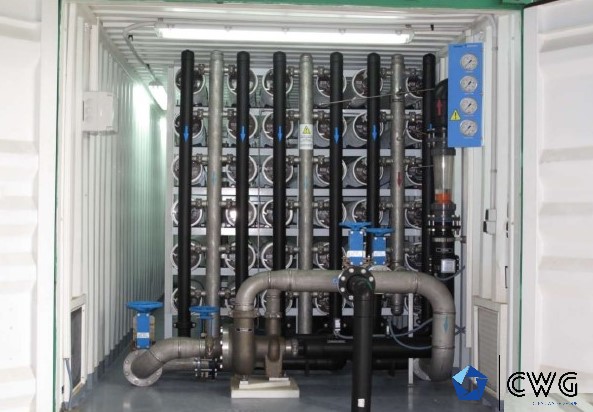
Production capacity must remain useful when demand changes, equipment is serviced or one supply barrier becomes unavailable. Intake, treatment, storage, power and operators are engineered as one service architecture.
MUNICIPAL DESIGN BASIS
Resolve these together before choosing a nominal plant capacity or container count.
Confirm the source-water analysis, seasonal range, intake yield and contamination risks before selecting BWRO or SWRO.
Population, public facilities, commerce, seasonal peaks, losses and emergency demand must be converted into a verified daily water balance.
Planned maintenance, membrane cleaning and equipment failure determine whether duty/standby or N+1 capacity is required.
Permeate quality, stabilisation, remineralisation, disinfection and distribution compatibility form one complete water-quality barrier.
Product-water storage separates continuous RO production from hourly network peaks and provides operational reserve during interruptions.
Automation, alarms, remote support, sampling points, chemical handling and service access must match the local operating team.
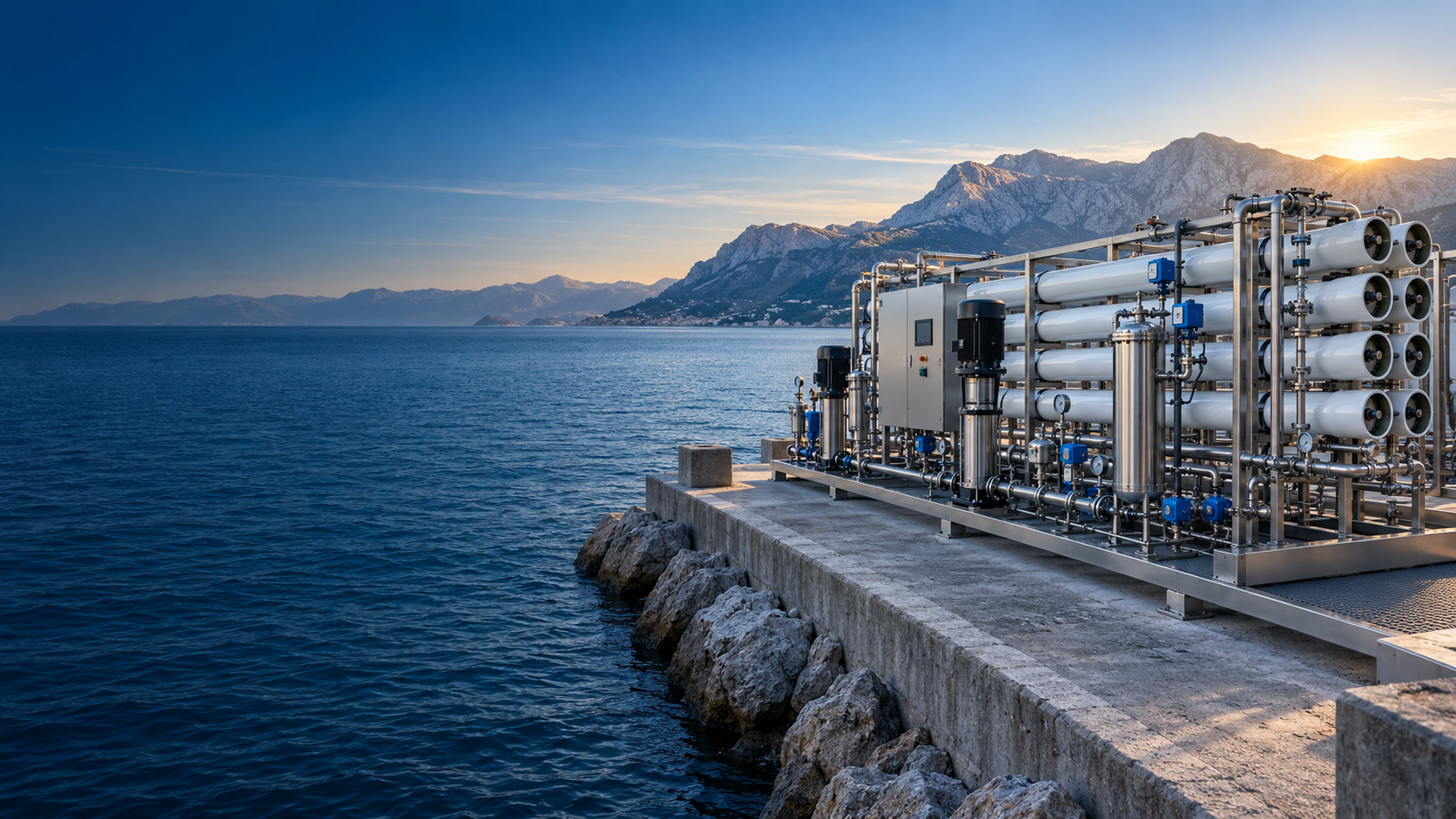
PRODUCT ROUTES
Small communities, public facilities and remote supply where the measured feed fits a KP conductivity configuration.
Open product familyEngineered modular seawater production with project-specific pretreatment, post-treatment, controls and train architecture.
Open product familyFactory-integrated containerized delivery for remote towns, islands, emergency capacity and infrastructure expansion.
Open product familyRanges are preliminary platform envelopes. Guaranteed flow, recovery, energy, materials and permeate quality require verified source water, temperature and project conditions.
TRANSPARENT CAPACITY LOGIC
Replace every illustrative assumption below with the utility's approved data, then assess reserve, storage and the required capacity during an outage.
AVAILABILITY ARCHITECTURE
Redundancy is meaningful only after shared dependencies are identified. Storage and another secure water source may form part of the resilience plan.
Lowest equipment count, but production stops during RO maintenance. Use only where storage or another supply source covers the accepted outage.
Two smaller trains share normal production. One train can remain online during maintenance, but available output is reduced.
One complete train carries design duty while the second provides full standby capacity, subject to shared-system dependencies.
Two trains carry design duty and one provides reserve. Staging supports demand growth and efficient partial-load operation.
POTABLE-WATER TREATMENT TRAIN
PROJECT BATTERY LIMITS
Clear interfaces prevent scope gaps between process equipment, civil works and the water network.
Review battery limitsDATA FOR A MUNICIPAL REVIEW
Send the source analysis, demand model, product-water requirement and resilience target. We will identify the DESAL route and missing engineering inputs.
The Finder provides a preliminary family match. Municipal train count, reserve, storage and potable-water barriers remain engineering decisions.
MUNICIPAL SUPPLY FAQ
No. Population is only one input. Verify local consumption, public and commercial uses, seasonal population, network losses, firefighting or emergency strategy, other water sources, operating hours, storage and future growth.
No. They are transparent arithmetic examples only. The actual design allowance must come from the responsible utility, project brief, local regulation and measured consumption data.
Not automatically. Final treatment can require stabilisation, remineralisation, pH adjustment and disinfection, followed by verified storage and distribution compatibility. The required barriers depend on feed water and the applicable potable-water specification.
Define the water output that must remain available during the largest credible planned or unplanned outage. Then identify shared dependencies such as intake, pretreatment, high-pressure pumping, post-treatment, power, controls and storage before assigning N+1 or duty/standby architecture.
BOX DESAL is a strong route when factory integration, weather protection, transportable modules and reduced site assembly are priorities. Intake, civil works, power, product storage, distribution and concentrate discharge remain project interfaces.
READY TO DEFINE THE WATER SERVICE?
We will connect the community duty to the correct DESAL platform, availability architecture and project data requirements.