DESAL-BWRO Q · BRACKISH-WATER RO · HL + L
DESAL-BWRO
Q12
Choose Q 12 when 50 L/h can cover the required daily volume within a realistic operating window and storage strategy.
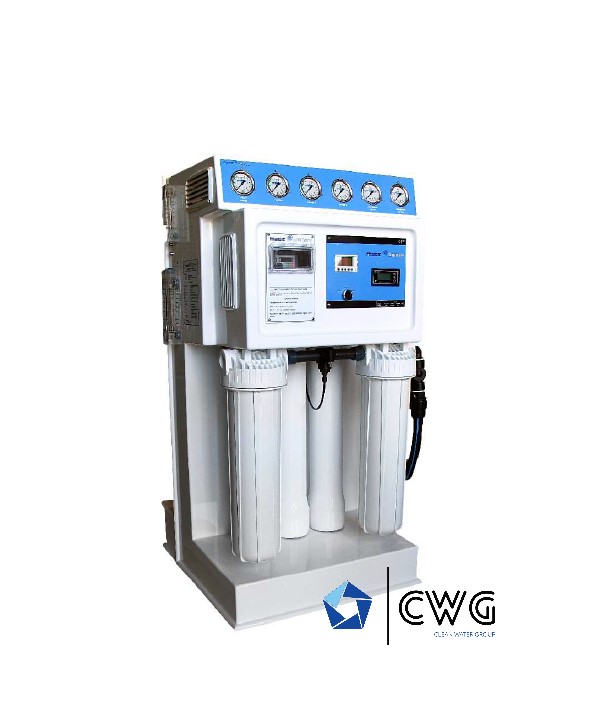
NOMINAL OUTPUT50L/h
HL · 6,000 | L · 10,000RATED FEED CONDUCTIVITY · µS/cm
Homes & small sitesCOMPACT APPLICATION
50L/hNOMINAL OUTPUT
1,200L/day24-HOUR RATING
HL + L6,000 + 10,000 µS/cm
Engineering gateWATER ANALYSIS REQUIRED
CONFIRMED PRODUCT DATA
Compact entry capacity for measured brackish-water duty.
Lower-volume brackish-water production for homes and small facilities where the verified feed fits the Q conductivity envelope. Public data is limited to confirmed capacity, conductivity class, application route and model reference; the final proposal defines the complete equipment and operating scope.
Check with Watermaker FinderCHOOSE BY MEASURED CONDUCTIVITY
One capacity. Two feed-water configurations.
Select the conductivity class from a current measurement, then verify full chemistry before recovery and pretreatment are approved.
DESAL-BWRO Q 12 HL
STD-0007€3,765approved net priceDESAL-BWRO Q 12 L
STD-0008€3,966approved net priceConductivity selects the catalog route.Hardness, alkalinity, silica, iron, manganese, turbidity, SDI, temperature and other source parameters define pretreatment and operating limits. Approved net prices exclude VAT and transport, EXW CWG Croatia. Final technical scope is confirmed after engineering review.
PRODUCTION PLANNING
Convert operating time into nominal water volume.
The calculation supports early storage and duty planning. It does not replace the verified output, recovery or permeate-quality commitment.
Operating timeNominal calculated volume
8 hours400L
12 hours600L
16 hours800L
24 hours1,200L
Calculation: 50 L/h × operating hours. The 24-hour result equals the catalog daily rating of 1,200L/day.TWO CATALOG CONFIGURATIONS
Match the unit to the measured feed-water class.
The capacity is identical. The conductivity configuration and approved net price changes with the verified source-water duty.
01
HL CONDUCTIVITY CLASSDESAL-BWRO Q 12 HL
Public model reference · STD-0007€3,765approved net price- 50 L/h nominal capacity
- 6,000 µS/cm rated feed conductivity
- Compact brackish-water application
02
L CONDUCTIVITY CLASSDESAL-BWRO Q 12 L
Public model reference · STD-0008€3,966approved net price- 50 L/h nominal capacity
- 10,000 µS/cm rated feed conductivity
- Compact brackish-water application
ANALYSIS · DUTY · PRETREATMENTWATER & SITE REVIEW
Conductivity finds the model. Chemistry protects it.
Conductivity & temperatureMeasured present value plus seasonal source-water range.Scaling chemistryHardness, alkalinity, silica and ions relevant to recovery.Fouling & pretreatmentTurbidity, SDI, iron, manganese, organics and microbiology.Site interfacesFeed supply, drain, power, storage, space and service access.
Send water analysis TECHNICAL DATA BOUNDARY
What the selected-code proposal must confirm.
These items cannot be inferred reliably from Q size and conductivity class alone. They remain dependent on the current manufacturer data, water analysis and project duty.
Electrical supply and connected loadOperating pressure and pump dutyMembrane configuration and recoveryDimensions, weight and installation layoutPretreatment and chemical-conditioning scopePermeate quality and post-treatmentControls, instruments and alarm functionsGuaranteed performance conditions
DESAL-BWRO Q12 FAQ
Answers before the technical proposal.
01How much water can DESAL-BWRO Q 12 produce?
The catalog rating is 50 L/h or 1,200 L/day at 24 hours of nominal operation. Actual output and guaranteed conditions depend on feed-water chemistry, temperature, pressure, membrane condition, recovery and the approved configuration.
02How do I choose between HL and L?
Use measured feed-water conductivity. HL is the 6,000 µS/cm rated configuration and L is the 10,000 µS/cm rated configuration. Conductivity selects the catalog route; full water analysis still determines pretreatment and operating limits.
03Can I select the configuration from a TDS estimate?
Do not automatically convert TDS to conductivity for final selection. The conversion factor depends on the dissolved ions. Use a current laboratory analysis or calibrated conductivity measurement in µS/cm.
04Does the online capacity guarantee drinking-water quality?
No. Nominal output does not define the final product-water specification. Required permeate quality, remineralization, disinfection, storage hygiene and applicable drinking-water requirements must be defined for the project.
05What data is required before quotation?
Send source-water analysis, measured conductivity, temperature range, required daily and hourly output, intended water use, operating hours, site utilities, installation constraints, storage and delivery location.
READY FOR CONFIGURATION REVIEW?
Send conductivity, analysis and required daily output.
CWG will confirm Q 12, the HL or L route, pretreatment, recovery and final product-water specification.